
CONTEXTSYNC
User Experience | Contextual Advertising | User Interface | Human-AI Interaction
OVERVIEW
My role: Product Designer
Focus: AI-powered contextual advertising
The mission: Stop ads from ruining the vibe
THE PROBLEM
You're reading a peaceful hiking blog. A loud car insurance ad flashes at the top.
It breaks your flow. Clashes with the aesthetic. Makes you feel tracked.
Everyone loses: you're annoyed, the advertiser looks tone-deaf, the publisher loses trust.
THE CHALLENGE
How might AI match ads to content context, tone, visuals, intent so they feel native instead of invasive?
WHAT USERS SAID
Nilay, 25, Grad Student:
"I get frustrated when ads distract me from what I'm reading."
Joshua, 35, Software Engineer:
"If I can give quick feedback, I feel like my input is valued."
Vishal, 28, Architect:
"Sometimes personalized ads can actually be helpful."
The insight: People don't hate ads. They hate irrelevant, disruptive ads.
THE SOLUTION
ContextSync: AI that reads the room before showing an ad.
How it works:
-
Analyzes page tone, colors, and user intent (not personal data)
-
Matches ads to content aesthetically and contextually
-
On-device processing for privacy
-
User feedback loop: "Relevant / Not for me / Report"
Before: Loud car insurance on a hiking blog
After: Hiking boots ad, styled to match the page, with "Why this ad?" transparency
THE PROCESS
First, documented the problem in the wild. Then mapped how users experience bad ads versus contextual ones. Finally, designed an interface that prioritizes relevance, transparency, and user control.

The problem in action (Source: Reddit)

Breaking down each stage: what users do, how the system responds, where they interact, and how they feel
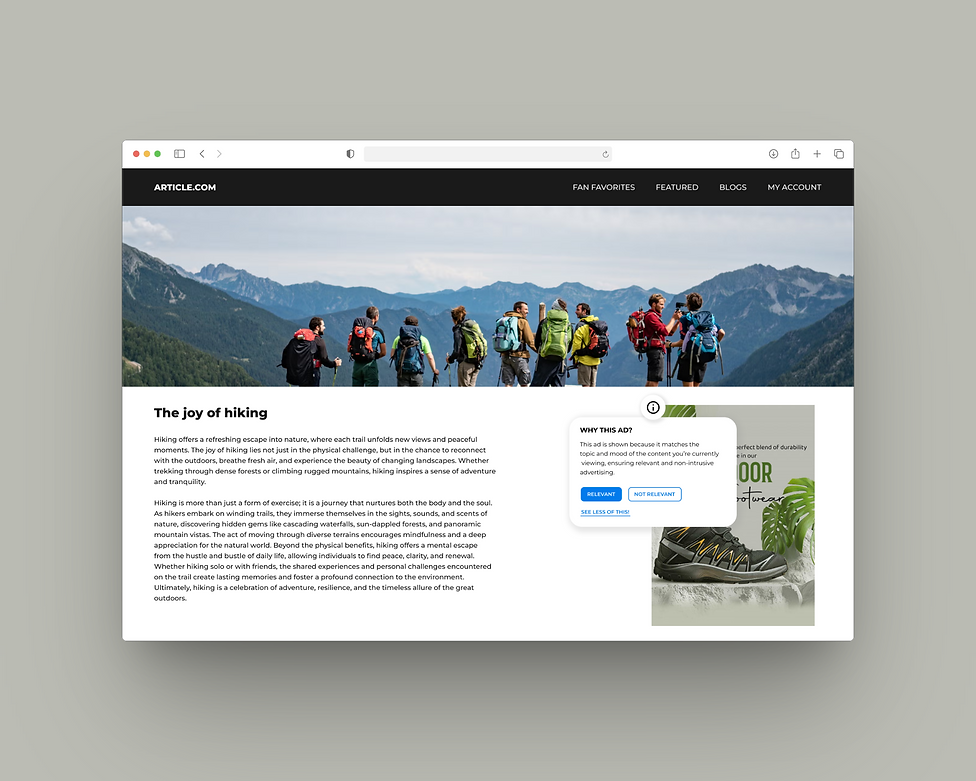
ContextSync in action: native ad + feedback + transparency
HOW IT ADAPTS
User reads hiking content ---> AI detects nature theme, calm tone, adventure intent
Ad appears ---> Hiking gear, green palette, matches page aesthetic
User gives feedback ---> "Not relevant" ---> System learns, adjusts future ads
Result ---> Over time, ads feel less intrusive, more useful
PRIVACY-FIRST
All analysis happens on-device or via privacy-preserving cloud.
No personal data harvesting. Just session context.
Each ad includes "Why this ad?" to build trust through transparency.
KEY FEATURES
✓ Context matching: Tone, visuals, intent alignment
✓ Transparency: "Why this ad?" micro-explanations
✓ User control: Quick feedback shapes future ads
✓ Privacy-aware: On-device processing, no tracking
✓ Aesthetic harmony: Ads styled to match content
TAKEAWAY
Good ads don't interrupt, they complement.
ContextSync proves AI can make advertising less invasive by actually reading the room first.